
Diabetes Prevention and Management for Members with Serious Mental Illness (SMI)


Why is it important?

Recent studies have shown a strong association between antipsychotic medication intake for serious mental illness (e.g., schizophrenia, bipolar disorder) and increased risk for the onset of Type II diabetes (Calkin et al., 2013, Citrome et al., 2011).  The goal of MBHP’s Diabetes Prevention and Management for Members with Serious Mental Illness (Diabetes SMI) project is to support Members in preventing, treating, and managing diabetes.  The main objectives of this project are to build on existing interventions and incorporate innovative strategies to achieve the following:
1.Prevent and/or delay the onset of diabetes among Members at increased risk due to their SMI and/or the addition of an antipsychotic medication, and
2.Manage and coordinate care for Members already diagnosed with diabetes and substance use disorders.

How is it measured?

The Diabetes SMI project applies the following HEDIS measure specifications to assess improvement efforts and performance outcomes to ensure MBHP's services align with national standards of care to meet the needs of Members at risk for diabetes:
1. Diabetes Screening for Members Taking Antipsychotic Medications for Bipolar Disorder or Schizophrenia (SSD): The percentage of Members 18 years of age and older who have been screened for diabetes after diagnosis with schizophrenia or bipolar disorder and prescription for an antipsychotic medication in the past year
2.Metabolic Monitoring for Children and Adolescents Taking Antipsychotic Medications (APM): The percentage of Members 1–17 years of age who have had two or more antipsychotic prescriptions filled and at least one metabolic test for blood glucose HbA1c and at least one test for low-density lipoprotein cholesterol (LCL-C) or total cholesterol each year
 
MBHPperformSMIbutton
Improvement Initiatives
What can I do?

How does MBHP perform against national Medicaid benchmarks?

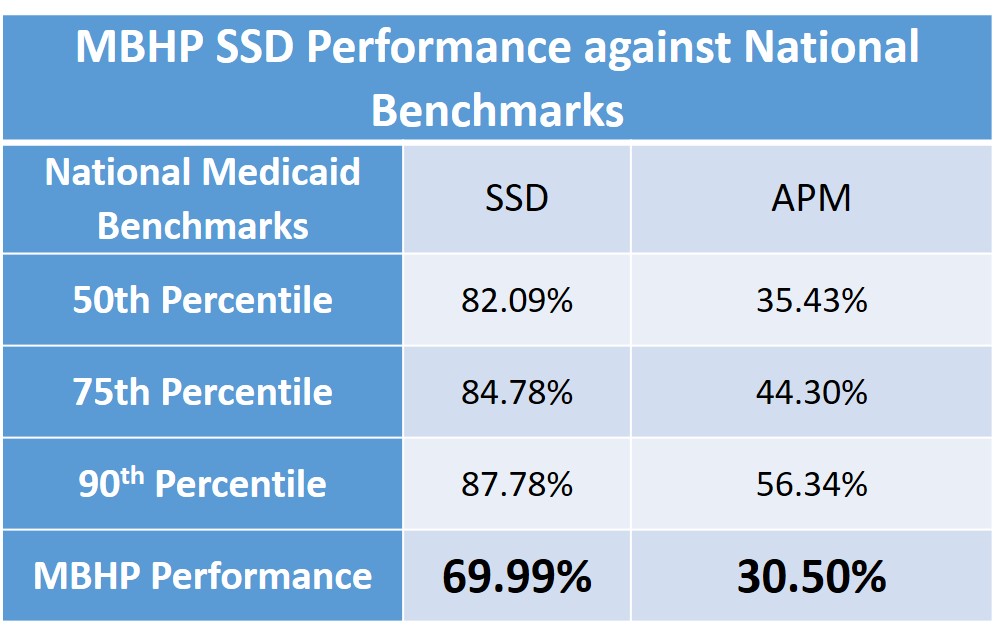
MBHP's plan-wide performance is 77.8 percent for the diabetes screening for adults measure (SSD) and 36.5 percent for the metabolic testing for the children and adolescents measure (APM - Glucose and Cholesterol).

The following table compares MBHP's performance against HEDIS 2021 national Medicaid benchmarks in the 50th, 75th, and 90th percentiles for the SSD and APM measures.
Diabetes SMI Performance

Based on MY 2022 rates on SSD and APM, MBHP did not meet the 50th percentile national Medicaid benchmark for SSD at 77.8 percent and met the 50th percentile for APM (Glucose and Cholesterol) at 36.5 percent.

MBHP Improvement Initiatives for Diabetes Screening and Metabolic Monitoring

MBHP's Quality Department organizes and implements improvement initiatives and educational opportunities that aim to achieve the following:
1.Inform providers on the importance of having Members diagnosed with serious mental illness screened for diabetes;
2.Promote coordinated care efforts through a team-based approach to better support Members in receiving the appropriate follow-up care and treatment; and
3.Identify opportunities and innovative strategies for increasing screening and metabolic monitoring across different levels of care.

Improvement Intiatives


Metabolic Mailing Screening Project: MBHP continues to identify Members without metabolic screenings through reviewing claims data and sends out reminder letters to providers who prescribe antipsychotic medications to youth and adolescent Members on Members who have not been screened for diabetes.  The letters remind providers about the importance of scheduling PCC visits and conducting metabolic screenings for Members on antipsychotic medication.  As young individuals are less likely to receive appropriate metabolic screenings compared to adults, the aim of this intervention was to promote integration, improve PCC follow-up rates, and ultimately improve metabolic screening rates for young people on antipsychotics.

Two-Way Communication Form: The Primary Care Clinician (PCC) Plan and the Massachusetts Behavioral Health Partnership (MBHP), along with Carelon Behavioral Health, Fallon Health, WellSense MA, Network Health, and Neighborhood Health Plan, have collaborated to create a single two-way communication form that can be used by all MassHealth providers to facilitate communication.  Behavioral health providers and PCCs can use the form when communicating with one another about a MassHealth Member.  The primary purpose of this form is to increase the frequency and improve the quality of communication between a Member's behavioral health provider and PCC to enhance the quality of services that lead to improved Member health outcomes through integrated care.  MBHP encourages behavioral health providers and primary care clinicians (PCCs) to use the two-way communication form to share information about their shared Members.  This form is intended to strengthen integration and coordination across levels of care and can be found here.

Release of Information (ROI) Form: MBHP continues to encourage Members to sign a Release of Information (ROI) in order to increase coordination of care between their different providers.  MBHP continues to provide education and advocacy on the importance of care coordination and provider partnerships to support best care outcomes for Members with SMI.  The purpose of providing this information to Members is to encourage self-efficacy in engaging in treatment.

Community Support Provider (CSP): MBHP’s CSPs provided support to Members with SMI by helping them overcome challenges to engagement in care, such as transportation, administrative work, and appointment coordination.  PQMs share fact sheets about CSP services and encourage their use during all provider meetings.

Supported Provider Quality Managers (PQMs) and PCC Support Managers (PCC SMs) in Understanding and Presenting Data to Providers: MBHP’s PQMs and PCC SMs are responsible for communicating about any educational materials (including one-pagers, two-way communication form, etc.) with network providers. In order to maintain consistency in MBHP’s health messaging and to ensure comfort and familiarity with the project aims, the MBHP Quality Program collaborates with PQMs and PCC SMs to ensure quality improvement and performance measurement messaging, including that the specifications of the SSD and APM measures are addressed consistently across network providers.

Partner with MBHP: If you are a pharmacy or provider interested in collaborating with MBHP on the Pharmacy Pilot Project, educational events, or other intitiatives to improve screening for diabetes among Members with Serious Mental Illness who are taking antipsychotic medication, please contact the Quality Department.

Best Practices for Diabetes Prevention and Management for Members with SMI


Request Provider HEDIS Diabetes SSD and APM Rates

If you are interested in learning more about your HEDIS Diabetes SSD and APM rates as a provider, contact the Quality Department below to request this information:

Contact Quality Department